 Trialist
Everyone online swears magnesium fixes your sleep. My first experiment said otherwise. Here's how I figured out I wasn't taking the wrong amount—I was taking the wrong kind.
Experiment 1: 200 mg, no change
I set up a simple experiment, tracked my sleep metrics, and took 200 mg of magnesium on “did it” nights. The result after a few weeks: basically nothing. My deep sleep and HRV looked the same with or without it. Easy to conclude “magnesium doesn't work for me” and move on.
Experiment 2: switch the source
Before giving up, I changed one variable—the source of the magnesium—and ran it again at the same dose. This time my sleep metrics improved. Same mineral, same 200 mg, completely different outcome. The form I was taking mattered more than the dose.
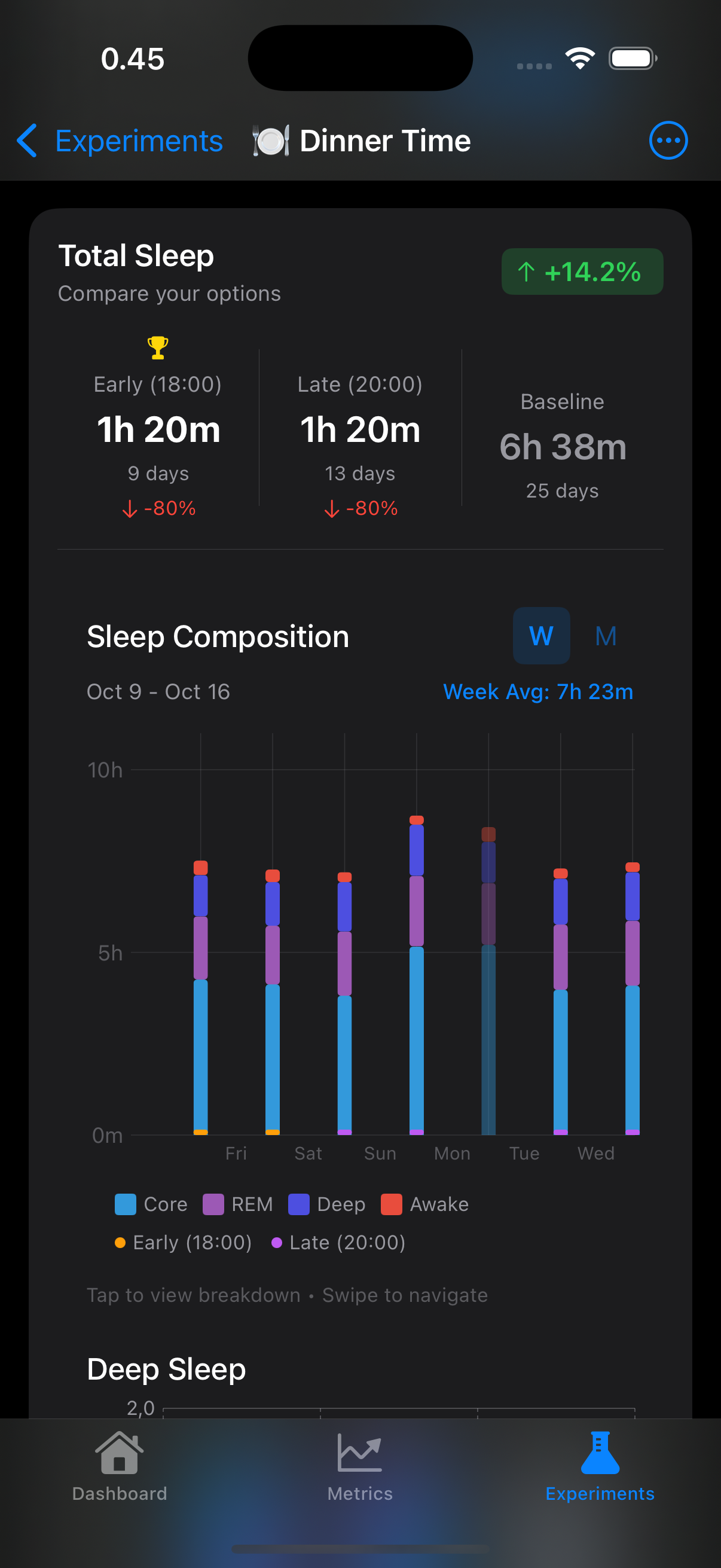
How the verdict was reached
No result gets shown until there's enough data to stand behind it.
Making sure it was really the magnesium
A better number is exciting, but I've been burned by coincidences before. So I used Compare to line up the two periods, and checked whether anything else had shifted while I switched sources—training load, alcohol, late caffeine, stress.
Because I tag those things in my journal as I go, the check was quick: nothing else moved enough to explain the change. The magnesium source was the standout difference.
The takeaway. “It didn't work” often means “that version didn't work.” Isolating one variable at a time—and confirming nothing else snuck in—turned a dead end into a keeper.